Review: Training for a Half Marathon with Nike Run Club
Key Takeaways
- Accessibility: The program is highly accessible and descriptive, largely due to the constant presence of a professional coach guiding you through the runs.
- Speed Work Emphasis: There is a heavy emphasis on speed work, which may pose significant challenges for both novice and seasoned runners.
- Race Preparedness: The race event itself went well and I felt well-prepared. While my time was slower than expected, that may have been a result of the race plan rather than the training.
Big Questions Answered Up Front
Would I recommend this to an individual interested in training for a half marathon? Yes, but with some heavy caveats.
Will I be using it again for future training efforts? Probably not the full plan, but I will definitely continue using their library for speed work-based tasks.
The Context: Summer Training for a Late Summer Race
I recently completed what feels like my sixth or seventh half marathon of the year. This one was unique in that it was a summer event; training began in April and culminated in August. Between starting in Florida and returning to Colorado in June, the majority of this training was conducted in extreme heat.

Previously, my training had focused solely on distance and heart-rate zones. I chose the Nike Run Club (NRC) for this event partly because my sister had used it, and because I knew it incorporated speed work—something I’ve struggled to maintain in past programs. I also had a friend new to running who was interested in training for the race, and I thought this program might be a good entry point for him.
Basic Structure of the Training Program
The weekly structure breaks down as follows:
- 1 Planning Run (15 minutes reviewing the week)
- 2 Speed Runs
- 1 Regular Run
- 1 Long Run
Lots of Talking
I start with “lots of talking” because there is an abundance of it. Each guided run features a professional coach talking you through the process. There were times when I deeply appreciated this and times when I found myself turning the volume down. However, this is perhaps the most significant aspect of the program: you receive a wealth of positive affirmation and practical techniques that can be incredibly impactful for a new runner.
The Planning Run
I particularly enjoyed the weekly planning run. At only 15 minutes, it is easy to fit into any schedule. Hearing what was coming up and the reasoning behind the workouts was a great way to build anticipation. Furthermore, if these weren’t guided runs, I’m not sure I would have stayed consistent with them. In a sense, this makes it a “4-day-plus” program, but it doesn’t feel significantly more demanding than the 4-day programs I’ve used previously.
The Regular Run
I’m not sure if “Regular Run” is the correct term, as I viewed these as easy Zone 2 mileage. In reality, I rarely managed to stay in Zone 2, primarily because of the intense heat during my sessions (and perhaps my failure to get out early enough).
Additionally, I rarely listened to the guided audio for these runs. I value my quiet time or the ability to engage with a book or podcast. Since three of the five weekly runs were already guided, I didn’t feel the need for more. That said, the weekly plans suggest these runs are designed to get you in the right headspace. I find it admirable that the program incorporates the mental side of the sport. For someone facing their first half marathon, these mindset-based discussions can be very influential.
The Speed Runs
This was undoubtedly the best part of the program. One run, for example, consisted of 20 repeats of 30-second mile-pace intervals. Managing such a workout on your own would be a royal pain—balancing motivation with the constant need to check your watch. By removing those barriers, the program makes it much easier to actually stick to the plan.
One point of confusion was the general progression. In the first two weeks, we performed a Fartlek, which didn’t seem perfectly aligned with the pacing strategies. Because you run continuously between intervals, I pushed too hard too early in the heat and ended up with an unexpected muscle strain in my shoulders.
I also encountered workouts involving full-out hill sprints. I’m not entirely sure why these are included in a beginner-focused program. If I were advising someone on this plan, I’d suggest taking it easy on the exercises from Coach Chris Bennett (the coach from LA), as they tend to be more intense than the others.
The Long Runs
The mileage for long runs progressed quite rapidly. I suspect this accounts for the lower total volume of the two speed-run days. However, it felt odd to perform multiple 10-mile runs in a short span. At one point, they prescribed a 12-mile run, which I simply completed as a full half marathon around week 10 or 11 of the 14-week plan. While it was fun to sneak in an extra distance run, it felt aggressive to push so close to the final race distance during training.
Similarly to the speed runs, I questioned the logic of the progression. While there may be a sound methodology I’m not intuitively grasping, it felt more “jumpy” than a traditional mileage-per-week approach that gradually ramps up total volume.
Race Results and Strategy
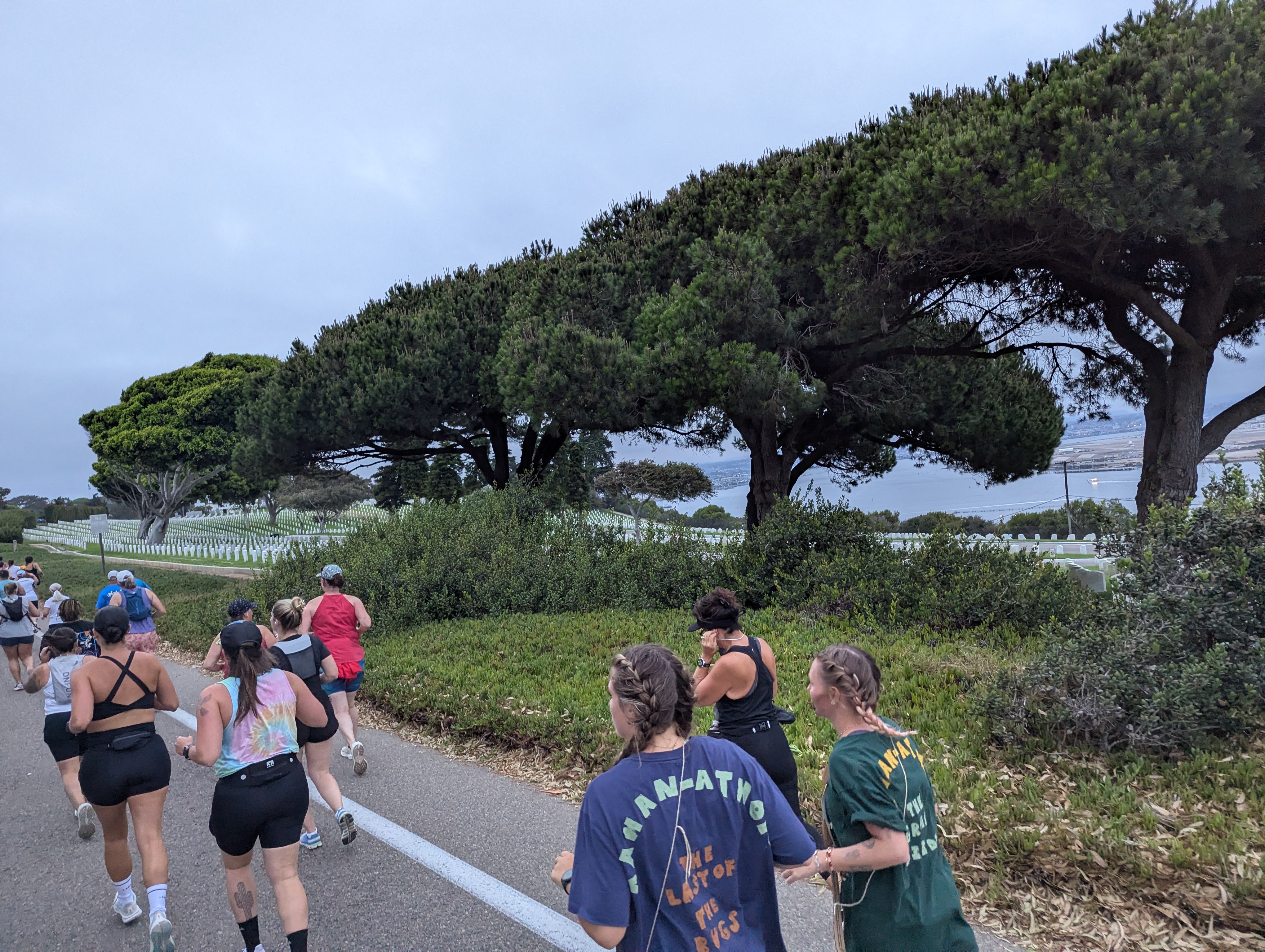
I ran the half marathon in San Diego. While I didn’t have a specific target time, I was excited to give it a hard effort. The sea-level boost and the effectiveness of my training gave me the confidence to push.
Consequently, I took the planning phase more seriously than in the past. I made deliberate choices regarding my wake-up and morning routines, which were highly effective. I also locked in a fueling strategy, finally biting the bullet to purchase GU gels for use on the course. Both were huge wins that I will continue to implement.
Where the plan let me down was the race structure. I attempted a heart-rate-limited race: high Zone 2 for the first three miles, high Zone 3 for miles 3 through 10, Zone 4 for 10 to 12, and an all-out finish for the final mile. While the strategy is sound in theory, it didn’t align with the course layout.
The first three miles of the San Diego race are primarily downhill, while the last three are primarily uphill. Because of this, I had to heavily brake at the start to stay within my zones, which was difficult given the energy of the starting line. Maintaining high Zone 3 through the middle of the course worked well; the pacing was slightly slower than I wanted, but it left me with a strong finish.
Race Splits Breakdown
| Segment | Zone | Distance | Pace (min/km) | Notes |
|---|---|---|---|---|
| 1 | Zone 2 | km 1 - 5 | 7:40 | Put on the brakes; downhill start |
| 2 | Zone 3 | km 6 - 16 | 7:20 | Quite a bit of variability on the splits |
| 3 | Zone 4 | km 17 - 19.5 | 7:00 | All uphill passing stretch |
| 4 | Zone 5 | km 20 - 21 | 5:20 | All-out finish |

A few things stood out. I felt incredibly strong at the end. That final uphill segment was a consistent exercise in passing people I had been running behind earlier in the race. I finished in the 72nd percentile overall, and I suspect I was in the 85th percentile during that final climb. It was highly motivating to feel like I was “winning” at the end. However, the fact that I could push so hard suggests I may have held back too much in the earlier stages.
Another highlight was the final mile; I was absolutely flying. My heart rate reached 185 to 190, which is very high, but I felt I could manage the intensity. I attribute this new threshold to the program, as it forces you to spend significant time in high-intensity zones.
Final Verdict
Would I recommend this plan to someone considering a half marathon?
It’s a qualified “yes.” There are many pros, but the recommendation depends on the runner’s goals. If the goal is simply to finish a first half marathon, the heavy speed work may be unnecessary and introduces avoidable risks of injury.
Furthermore, while the program describes the intuitive feel of different paces (10k, 5k, and mile pace), these concepts are likely more intuitive for established runners. A beginner may be used to “running for play”—sprinting and stopping—rather than sustaining distance. I suspect a novice might overcommit to the speed workouts and fail to run slowly enough on easy days. Whether to use heart rate monitoring or a guided pace is a trade-off with its own set of cons.
TL;DR: No, unless I can first discuss the person’s goals and running experience. Yes, if they are ready to handle the nuances and intensity baked into the program.
Will I be using this program again in the future?
Maybe. I still feel the mileage and speed work progressions are a bit opaque. If I use it again, I’ll be more deliberate: creating a scaling mileage plan while selectively integrating speed work sessions from their library.
The abundance of guided audio has its pros and cons, but overall, I’m glad I gave the program a chance.
-->